.svg)

Recently, the Indonesian government revoked the business permits of 28 companies operating in Aceh, North Sumatra, and West Sumatra, citing violations related to forest use and land management.The decision followed growing concern over environmental damage, land misuse, and the increasing risks of floods, landslides, and ecosystem collapse across Sumatra.
While this news focuses on large-scale operators, the message is broader and unavoidable: unchecked deforestation has real consequences, and Indonesia is beginning to act on it. Source : detik.com
Why This Matters to Mentawai
Mentawai may feel far from the centers of industry, but we are not disconnected from these realities.
Our forests:
- protect river systems and coastlines
- stabilize soil during heavy rainfall
- support reefs through clean runoff
- provide materials for housing and boats
At the same time, many local livelihoods still depend on practices that quietly pressure those same forests — including the cutting of large trees to build dugout canoes and wooden boats that often last only a few years.
When trees are cut faster than they can recover, the impact is cumulative:
- weaker watersheds
- more sediment reaching the reefs
- increased erosion and flooding
- fewer resources for future generations
This is not about blaming communities.
It is about acknowledging that the old solutions are becoming risky — environmentally, economically, and socially.
A Practical Alternative: Boats That Don’t Come From the Forest
At Mentawai Surf Camp, we see boats as more than transport.
They are the backbone of island life — for tourism, fishing, safety, and daily movement between villages.
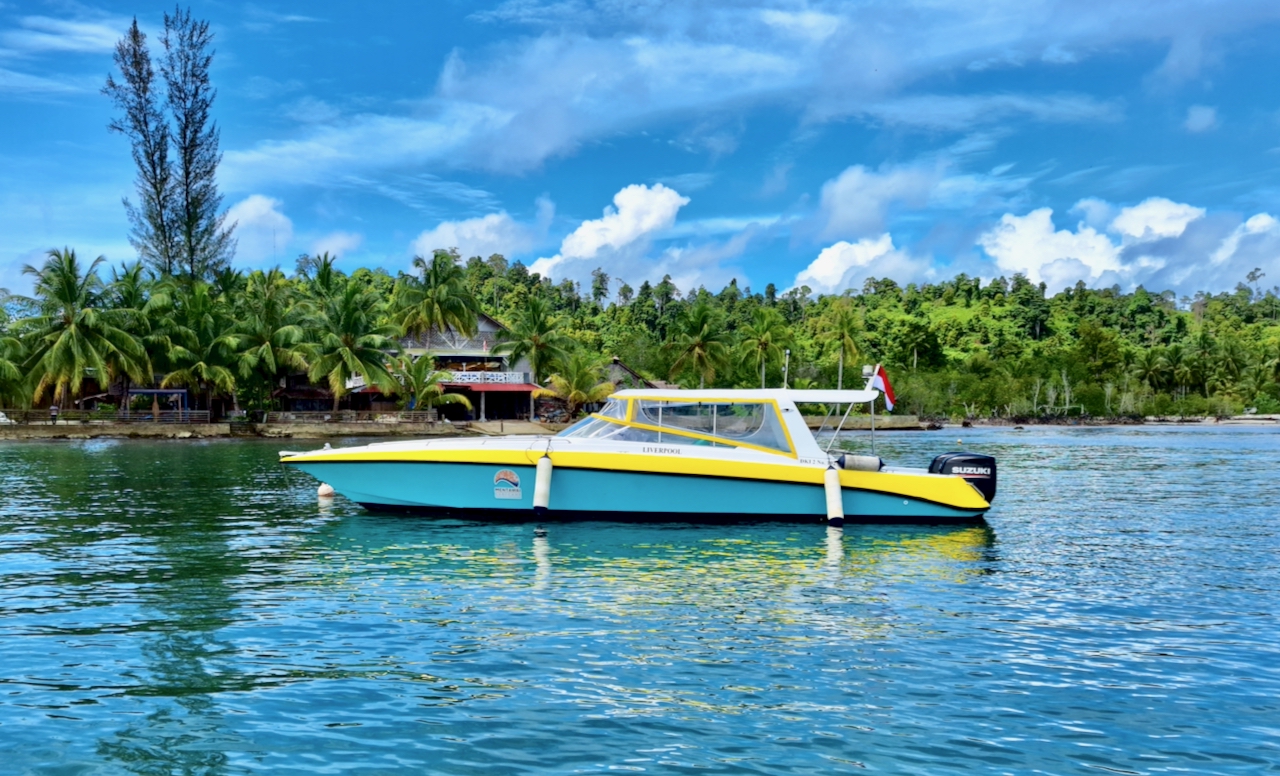
That is why, over recent years, we have been developing and using fiberglass boats as an alternative to forest-dependent wooden vessels.
Fiberglass boats:
- do not require cutting mature trees
- last significantly longer
- are safer offshore
- are more fuel-efficient when designed properly
- can be repaired and maintained locally
By investing in these boats, we are trying to address a root problem rather than treating the symptoms.
What This Means for Locals, Operators, and Resorts
Moving away from forest-based boat building is not about abandoning tradition — it is about protecting livelihoods.
For local communities:
- longer-lasting boats mean fewer replacements
- safer transport means fewer accidents
- skills in fiberglass repair create new income paths
For operators and resorts:
- more reliable fleets
- lower long-term costs
- reduced environmental risk
- alignment with emerging national enforcement trends
For the forests:
- fewer large trees cut
- less pressure on already fragile ecosystems
- more time for regeneration
This is how sustainability becomes practical — not through slogans, but through tools that work.
Learning From What’s Happening Elsewhere
The revocation of forest licenses across Sumatra is a signal.
Large-scale deforestation is being questioned more openly, and enforcement is increasing.
For places like Mentawai, this is an opportunity:
- to move early
- to adopt alternatives voluntarily
- to avoid future disruption
- to protect both nature and local economies
We believe small, local decisions — repeated consistently — matter just as much as national policy.
Looking Ahead
We are continuing to:
- build and refine fiberglass boats
- train local staff in maintenance and repair
- share practical knowledge with other operators
- explore ways to reduce pressure on Mentawai’s forests
This is not a finished journey.
But it is a direction we believe in — one that supports people, protects forests, and keeps island life moving forward.